
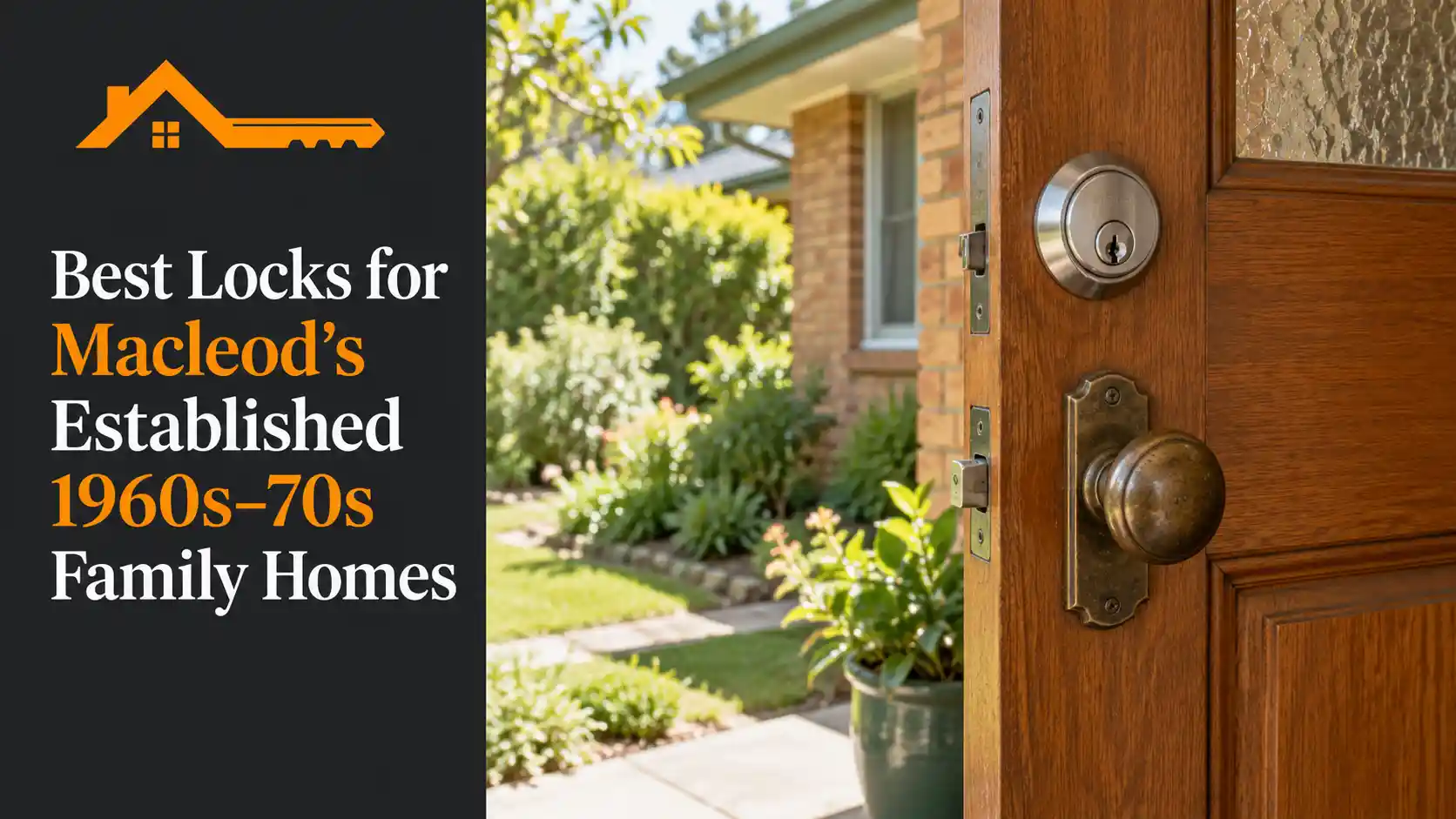
Drive through almost any of Macleod’s established residential streets and you’ll see the same general housing type repeating: solid brick veneer construction, generous corner blocks, double-hung or aluminium sliding windows, wide frontages with a separate garage or carport, and a rear garden that backs onto a lane or another property’s fence. These are the homes that gave the suburb its family character, and there are thousands of them across the streets between Macleod station and the Bush Reserve.
They’re also homes that present a very specific set of challenges for anyone doing lock work — challenges that are easy to underestimate if you haven’t spent significant time working on this era of construction.
I work on these houses regularly, and the questions I get most often from Macleod homeowners come down to some version of: what lock should I actually put on this door? Here’s an honest answer.
Why This Era of Home Needs Specific Advice
The 1960s and 1970s construction standards in Melbourne produced strong, lasting housing — these homes have stood up well and will continue to for decades. But they were built at a time when residential security hardware was designed to a very different threat environment, and when the materials and techniques used in door construction reflected what was available and affordable at the time.
Timber entry doors from this period frequently use non-standard backset dimensions that don’t match the modern 60mm or 70mm standards that most replacement lock sets are designed around. Installing a standard modern deadlock into one of these doors without properly assessing the backset often results in a lock that doesn’t sit flush, doesn’t engage cleanly, or puts stress on the door frame in a way that creates problems over time. I’ve seen plenty of these botched installations — done by locksmiths who defaulted to a standard product without looking at what they were actually fitting into.
The timber itself has also had fifty to sixty years to move. Doors that once hung true have often shifted slightly in their frames, and a lock that’s fitted without accounting for that drift tends to develop alignment issues relatively quickly.
Deadlocks: The Non-Negotiable for Timber Entry Doors
The single most impactful lock upgrade for Macleod’s established homes is a properly fitted deadlock on every external timber door. Not a knob lock, not a lever handle set — a proper deadlock that extends a solid bolt into the door frame independently of the handle, requiring the key to both lock and unlock it.
A lot of these homes still have the original cylindrical knob locks or lever sets that came with the house, which offer surface-level resistance at best. A knob lock can be defeated by gripping and twisting, and it doesn’t provide the independent bolt action that a deadlock does. For the front entry, rear entry and any side door that gives access to the interior of the home, a grade-rated deadlock is the baseline.
The key is making sure the deadlock is correctly matched to the door’s backset, fitted into a reinforced strike plate with proper-length screws into the structural frame, and seated properly in the door so the bolt engages without stress. A deadlock poorly fitted into a sixty-year-old door frame can actually make things worse by giving a false sense of security while the strike plate pulls out under minimal load.
Pro Tip: When a locksmith instals a deadlock in a period home, ask them specifically about the strike plate — a short-screw strike plate in a timber lining is the most common weak point on these doors.
Sliding Doors: The Most Overlooked Vulnerability
If there’s one feature of Macleod’s 1960s-70s homes that creates a consistent security gap, it’s the rear aluminium sliding door. These were the contemporary choice for rear garden access when these homes were built, and a lot of them are still in original or near-original condition — meaning the locking mechanism hasn’t been updated in five or six decades.
Original sliding door locks on this era of home typically consist of a simple lever handle with a basic face latch — it keeps the door closed against the wind, but it’s not a serious security barrier. The most common attack on these doors isn’t even through the lock mechanism — it’s lifting the door panel off its track entirely, which requires no tools and can be done in under a minute on an unmodified original installation.
The appropriate fix for Macleod’s sliding doors is a two-part upgrade: an anti-lift device fitted to prevent the panel being lifted out of its track, combined with a secondary lock — either a key-operated sliding bolt or a track blocking bar — that provides actual resistance to the door being forced horizontally. Both components together cover the two most common attack methods, and neither modification requires replacing the door or making structural changes to the frame.
Window Locks for Timber Frames
The original windows on Macleod’s established homes fall into two general categories: double-hung timber sash windows on the older sections of the property, and aluminium framed sliding windows in areas that were updated in the 70s or 80s. Both types, in their original state, typically have latches rather than locks — meaning they can be fastened closed but not actually locked against external opening.
For timber sash windows, key-operated sash locks can be fitted into the existing timber frame without modifying the glass, the sash or the external appearance of the window. They’re discreet, they work with the existing timber, and they convert a fastened-but-not-locked window into one that actually needs a key to open from outside. For aluminium sliding windows, similar key-operated locking mechanisms are available that clip into the sliding track and prevent the window being slid open beyond a set position.
Ground-floor windows on any face of the property that isn’t clearly visible from the street or a neighbour’s view deserve this treatment at minimum. The effort is low, the cost is modest, and it closes what’s consistently one of the most used entry points in post-incident assessments on this era of home.
Pro Tip: A window that latches shut looks the same from inside as one that actually locks — check which type you have on every ground-floor window of your Macleod home.
Smart Locks and Older Homes: What Works
Macleod homeowners ask about smart locks increasingly, and they can be fitted to these older homes — but with some specific considerations. The non-standard backsets and thicker-than-modern door profiles mean that many off-the-shelf smart lock sets need to be assessed against the specific door before purchase, rather than ordered from a catalogue. The good news is that there are retrofit smart lock cylinders that mount on the internal face of an existing deadlock, keeping the external hardware entirely original while adding app-based access and remote locking, which is often the cleanest solution for a period property.
Battery-powered systems are generally preferable for these homes because running mains wiring through original brick or timber construction is disruptive and often unnecessary. Battery life on current smart lock systems is typically eighteen months to two years with normal family use, and low-battery alerts give ample warning before any issue occurs.
What I Found When I Assessed a Macleod Home Last Summer
A homeowner in Macleod — a 1968 brick veneer on a corner block near the station — called me after a neighbour’s property two streets away was broken into. She wanted a security assessment but wasn’t sure what she actually needed.
When I walked the property, the front door had a good-quality deadlock that had been upgraded a few years earlier. The rear timber door to the laundry, however, still had the original lever handle and a surface bolt — not a deadlock. The aluminium sliding door off the dining room had the original face latch and nothing else: no anti-lift, no secondary lock. Four of the five ground-floor windows had original latches with no key-operated component.
The front of the house was reasonably well secured. The entire rear and side profile wasn’t.
What this homeowner had — without knowing it — was a security setup that was strong on the elevation everyone could see and weak on the elevations nobody could see from the street. It’s a pattern I see constantly on these Macleod properties, and it’s almost always the result of upgrades being done reactively (after a scare, or when replacing a failed lock) rather than systematically. The front door gets replaced when it looks shabby. The rear door doesn’t get attention until something happens.
A proper walk-through of a period Macleod home takes about an hour and maps the actual security picture across the whole property, not just the obvious points.
A Practical Upgrade Priority for a Macleod Established Home
For homeowners trying to decide where to invest first across a 1960s-70s Macleod property, the order that delivers the most security per dollar is generally: deadlock on the rear entry door first (most commonly the weakest external entry point), then anti-lift and secondary lock on the sliding door, then key-operated locks on ground-floor windows, then front entry deadlock review. Most Macleod homeowners have already thought about the front door — it’s the back of the property that consistently needs catching up.
