
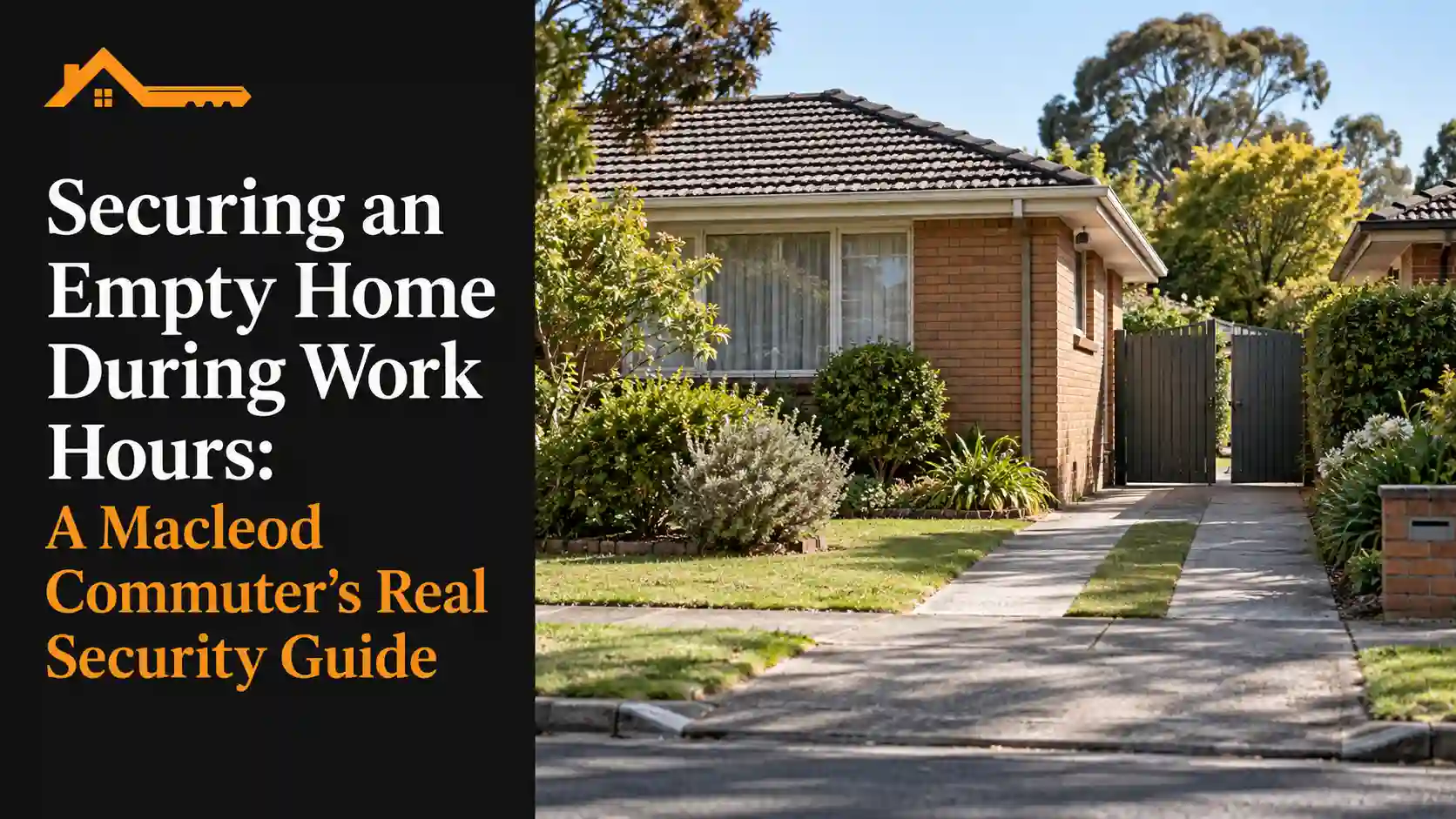
Macleod is, at its core, a commuter suburb. Walk to the station on a weekday morning and you’ll see it — a steady stream of residents heading down to catch the Hurstbridge Line, heading into the CBD for work, into Heidelberg for the hospital precinct, into Doncaster for the retail strip. By eight-thirty on a Tuesday morning, a significant portion of Macleod’s 9,892 residents have left for the day. The streets go quiet. The driveways empty out. And for a few hours, the suburb’s houses sit unattended.
That’s the window that residential burglaries in this area tend to exploit. Not the dramatic late-night break-in of the movies — actual daytime entry, on a weekday, through a rear door or side window, in a suburb where everyone’s at work and nobody’s watching.
Banyule LGA, which covers Macleod, has seen break-and-enter crime climb 75% in the past two years. That’s a real number, and it changes how seriously daytime security needs to be taken in this suburb — even by residents who’ve always thought of Macleod as a safe, low-key place to live.
Why Commuter Suburbs Have a Specific Security Problem
The same quality that makes Macleod desirable — quiet, established residential streets, large blocks, good tree cover — creates a set of conditions that makes daytime intrusion easier to carry out undetected. A leafy property with established plantings around the fence line offers natural screening that a homeowner loves for privacy and that a burglar appreciates for the same reason. Wide, generous lot sizes mean that rear and side access is often out of view from the footpath.
Add to that the predictability of commuter routines. A suburb where most residents leave at similar times and return at similar times isn’t hard to observe. Anyone who spends a morning watching a Macleod street can get a pretty clear picture of which houses are regularly empty from 8am to 6pm. That pattern is what transforms an opportunistic attempt into something more deliberate.
The fix isn’t to panic — Macleod is still a well-functioning community where most residents never experience a break-in. But it does mean thinking about security with the actual risk profile in mind, not the risk profile you’d apply to a different kind of suburb.
The Entry Points That Actually Get Used
When I do post-break-in assessments in Macleod, the same pattern shows up consistently. The front door — the one homeowners have usually spent the most money on — is rarely the actual entry point. It’s the most visible from the street, which is exactly why it gets avoided.
Rear sliding doors are one of the most commonly exploited entry points in the older-style homes that make up most of Macleod’s established streets. The original 1960s and 1970s aluminium sliding doors that are still in place on a lot of these properties were not engineered with current security in mind, and even after forty or fifty years of daily use, the locking mechanism is often exactly the same one that came from the factory. A basic anti-lift device and a secondary lock on every sliding door is one of the most impactful upgrades a Macleod homeowner can make.
Ground-floor windows — particularly on the sides of a property that aren’t visible from either the street or an adjacent neighbour’s yard — are the second most common entry point in post-incident walk-throughs I’ve done in this suburb. Original timber sash and casement windows from this era of construction often only latch closed rather than locking, and a latched window is not the same thing as a locked one.
Pro Tip: A sliding door with no anti-lift pin can be lifted out of its track from the outside in seconds — it costs less than $50 to fix, and it closes one of the most common entry points in Macleod homes.
What a Daytime Security Audit Looks Like
The most useful thing a Macleod homeowner can do before spending money on hardware is to walk their property the way they wouldn’t normally. Leave the house and come back in through the side gate. Look at the rear garden from the back fence. Stand at the point where a stranger would approach if they wanted to get in without being seen from Aberdeen Road, and ask yourself what they’d actually find.
In practice, this exercise usually reveals three things: the rear door lock is weaker than the front, at least one ground-floor window is reachable and latched rather than locked, and the side gate has something basic on it — a bolt or a basic latch — rather than a proper lock. Those three weak points are also the three I find on almost every Macleod property I assess that’s had an attempted or successful break-in.
A professional security assessment from a local locksmith covers the same walk-through with the added knowledge of what lock upgrades are compatible with this specific era of door and window, what can be installed without modifying the frame or glass, and what’s likely to actually stop an opportunistic intruder versus what just looks like an upgrade.
Practical Upgrades That Work for This Housing Era
Macleod’s 1960s and 1970s housing stock responds well to a set of security improvements that don’t require structural modification and work with the existing door and window frames rather than against them. Deadlocks on rear and side entry doors are the most fundamental — a mortice deadlock on a rear timber door is significantly more resistant to forced entry than the original cylindrical knob lock that many of these homes still have. Key-operated window locks fitted to original timber sash windows add security without replacing the glass or the frame, preserving the home’s original look while closing a genuine vulnerability.
For sliding doors, a combination of an anti-lift mechanism (preventing the door being lifted from its track) and a secondary blocking bar or lock in the sliding track provides real resistance against the common methods used on these older aluminium doors.
Pro Tip: Check your side gate first — if someone can walk in from the street to your rear yard without bypassing a proper lock, everything behind the gate is already accessible.
Timers, Lighting, and What They Do and Don’t Do
Visible deterrents — security lighting, timer-controlled lights and radios — genuinely have value, but it’s worth being clear about what they do and don’t do. A well-lit rear yard removes the cover of darkness that an intrusion depends on, but most Macleod daytime break-ins don’t happen in darkness. A light that turns on at the motion of an approaching figure in daylight doesn’t deter much because it’s already daylight.
What visible deterrents do best is create the impression of occupancy during the evening and early morning — the shoulder periods around a work commute when a home is empty but not yet in full daylight. Combined with solid physical locks on the actual entry points, they form part of a layered approach rather than a standalone solution.
The goal for a Macleod commuter home isn’t a fortress. It’s removing the easy opportunities that a daytime opportunist is actually looking for, so that your home gets passed over in favour of one that’s left an obvious gap.
A Real Job That Changed How I Think About Macleod Security
I was called to a property on Alamein Road in Macleod after a daytime break-in. The family had been commuting — both parents out by 8am, kids at school — and returned at six in the evening to find the rear sliding door had been forced. The front door was untouched. The windows at the front of the house were locked. The alarm was set and had gone off, but by that point the entry and exit had taken less than five minutes and the neighbours — equally gone for the day — hadn’t heard it.
What struck me when I walked through the property wasn’t how sophisticated the intrusion was. It was how straightforward it was. The sliding door anti-lift mechanism had never been fitted. The side gate had a basic bolt. A single point of approach, about thirty seconds of work, and the whole rear of the property was open. Everything else the family had spent money on — the alarm, the quality front door lock — wasn’t relevant to the entry point that was actually used.
The upgrade we did that afternoon was not expensive. It was also not something that required me to rebuild their security from scratch — just to close the specific gap that existed. That gap is present on a significant number of Macleod’s established homes, and the only way to know whether yours has it is to actually look at the rear and sides of the property with the same attention most people give the front.
Security for the Hours You’re Not There
A suburb of Macleod’s profile — median house value over a million dollars, established family homes on generous blocks, clear commuter rhythms — deserves security that matches the realities of how these houses are lived in. The risk isn’t dramatic or inevitable. But it’s real, and it’s risen sharply in Banyule in recent years. Taking the daytime hours seriously, addressing the rear and side entry points that actually get used, and doing a proper walk-through of your own property is how Macleod homeowners stay ahead of it.
